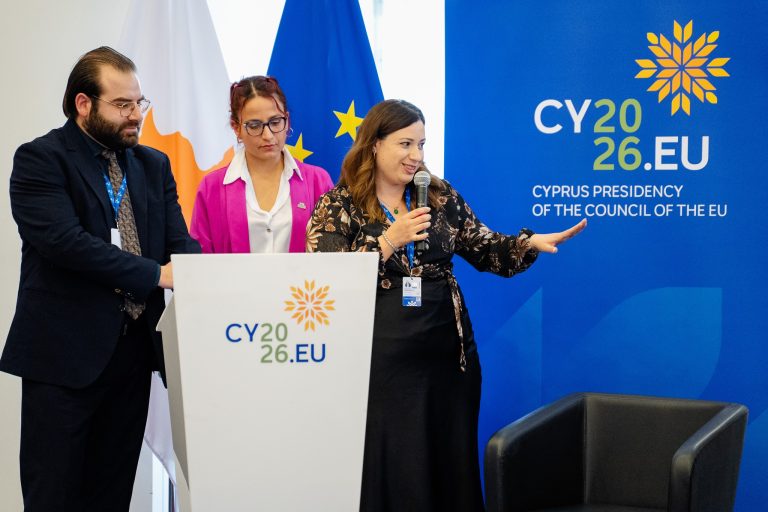
Young people from across Europe came together to develop ideas on how the EU can better connect with young people.
Following a move to an online format due to the situation in the Middle East, the EU Youth Conference under the Cypriot Presidency took place from 18 to 20 March 2026. The theme was “Making the EU Youth-Friendly – Ensuring the youth-friendliness of policies at national and EU level”.
During the Conference, youth delegates and ministerial delegates were divided into 8 different workshops, each one on a different thematic area. Those were:
- Youth Policy Pitch: Make the EU Work for Us
- What Makes a Policy Youth-Friendly?
- From Dialogue to Decision: Decision-making with Young People
- Building Beyond 2027: The Future EU Youth Strategy
- Speaking Youth: How Can The EU Communicate Better With Young People?
- Civic Education and EU Awareness: Empowering Youth for Active Citizenship
- Strengthening Trust and Transparency in EU Institutions through Youth Involvement
- Bringing the EU Closer to Youth through Youth Work and Mobility Initiatives
The recommendations that emerged from these discussions will be consolidated in the Council Resolution, which will be adopted later during the Cypriot Presidency and will serve as the political conclusion of the 11th cycle of the EU Youth Dialogue. The Conference will also contribute to a second Council Resolution revising the EU Youth Strategy Work Plan for 2025–2027.
Stefanos Agathokleous from Eurodesk Brussels Link took part in Working Group No. 5: “Speaking Youth: How can the EU communicate better with young people?” The group explored how the EU can improve its communication strategies to better engage young people, using youth-friendly language and formats to foster inclusivity and transparency, while effectively showcasing the EU’s impact on young people’s everyday lives.
This aligns with Eurodesk’s recommendations for the next Erasmus+ programme: simplifying processes and improving user-friendly communication to make the programme more accessible for young people and relevant organisations, increasing motivation to participate, and ensuring that support reaches those who need it most.
Here are the recommendations each Working Group presented:
WG1 – Youth Policy Pitch: Make the EU Work for Us
To protect young people’s access to housing, the European Commission should create an Overcrowded City List initiative to reduce housing pressure, and also provide stronger support for student accommodation in Erasmus+.
The EU should protect young people’s access to housing with two measures. Firstly, building on Regulation (EU) 2024/1028, the EU should create an Overcrowded City List of areas where short-term rentals intensify housing pressure, using indicators such as short-term rental density, inflation, tourist concentration and the share of entire-home rentals. Listed cities should then be empowered to impose proportionate rent caps, zoning rules, and stricter limits on investor-led short-term rentals, backed by mandatory host registration and monthly data-sharing with authorities. Secondly, Erasmus+ should ensure minimum standards for Erasmus+ accommodation, supply, transparent allocation and pre-arranged options, while adjusting Erasmus+ grants to reflect real housing costs, for instance, through a dedicated chapter on housing. During Erasmus+, young people often struggle to find suitable accommodation because the current system lacks a structured mechanism for addressing housing stress.
WG2 – What Makes a Policy Youth-Friendly?
To create participation standards for the development of youth-friendly policies. These should ensure mandatory and meaningful inclusion of young people across all policy development stages, clearly state institutional mandates, and promote structured, transparent feedback mechanisms.
At present, instruments for youth participation often fall short of being meaningful, as they largely remain consultative and lack mechanisms to influence decision-making. European young people do not feel heard, and it is unclear how policy proposals progress after they are delivered to decision-making bodies. Youth-friendliness is ensured through meaningful participation based on clear criteria. Therefore, the EU should focus on strengthening and developing legally binding standards for mandatory youth participation, building on existing instruments (e.g., the EU Youth Dialogue and the EU Youth Check/Test). This should also be part of the next EU Youth Strategy. These standards should include a fixed timeline for proposals, along with an explanation of how they were addressed and implemented, or why they were not. This increases transparency and ensures that bodies value youth input on policy proposals.
WG3 – From Dialogue to Decision: Decision-making with Young People
To establish a single accessible, inclusive, long-term, digital feedback mechanism across all EU institutions to ensure continuous monitoring of youth recommendations made within participatory mechanisms, transparent communication of results, and active youth involvement in evaluation.
Strengthening the feedback loop addresses two key challenges: increasing youth involvement, understanding, and trust, and ensuring decision-makers are held accountable. A continuous monitoring system by EU institutions, supported by a digital feedback tool, should monitor how recommendations are used over time while actively engaging with youth on their development. Participants need clear, regularly updated information on what happens during their engagement and with the results of their deliberations. Institutionalising this process places greater responsibility on decision-makers and ensures transparency and accountability in the integration of young people’s recommendations into policy outcomes.
WG4 – Building Beyond 2027: The Future EU Youth Strategy
To mainstream youth topics across all Directorates and policy areas, the European Commission should better utilise existing tools such as the EU Youth Dialogue and the European Youth Goals.
This is important because it ensures improved follow-up of the EU Youth Strategy. It allows young people’s concerns to be considered widely across all policy areas, rather than focusing on youth-specific policy topics. Possible actions to enable this could include:
Adding specific indicators and objectives to each Youth Goal, including a mention of the relevant Directorate General to work on this.
Include the targets within youth goals in the annual work programme of each relevant Directorate General.
Allow young people to provide policy input on the topics of the Youth Goals and co-create concrete policy measures on relevant topics within the EU.
WG5 – Speaking Youth: How Can the EU Communicate Better with Young People?
To adopt supportive and inclusive communication strategies on policy making at the European and national levels, ensuring that youth-friendly information is available in both digital and non-digital formats accessible to all.
The institutions should use simpler, less technical and more youth-friendly language to include young people. The emphasis should be placed on in-person communication and interpersonal connection, and not only on digital communication. Inclusive communication with people with disabilities and underrepresented groups should be supported. Barriers in the EU consultation processes should be removed, and more open and large-scale consultations on European youth processes should be promoted. Also, there should be fewer communication channels, and an emphasis should be placed on a more centralised way of communication. The institutions should train people who work on communicating youth policies on inclusive communication practices. The EU should be more visible in public spaces by using integrated communication in the Member States and their national institutions.
WG6 – Civic Education and EU Awareness: “Empowering Youth for Active Citizenship”
To support non-formal learning in formal education settings within Erasmus+, by creating earmarked funding and mandating collaboration between educational institutions and civil society organisations.
Many young people feel a lack of knowledge about the EU, which clearly highlights a gap in the formal education system, particularly in relation to civic education. The European Commission should ensure that the new Erasmus+ Programme (2028–2034) has earmarked funding for non-formal education activities that foster civic engagement, knowledge about the EU, and soft skills within the formal educational sphere. This should be done by requiring all applicants (Educational Institutions) to partner with civil society organisations that provide non-formal education. This will create a space for educational institutions to tap into the knowledge and resources civil society organisations have in domains such as knowledge about the EU or civic education, complementing the strengths of both partners. Introducing this condition would ensure more steady funding and support, resulting in growth within organisations working in the non-formal education sector.
WG7 – Strengthening Trust and Transparency in EU Institutions through Youth Involvement
To follow up on the EU Youth Conference recommendations, the EU institutions should establish a feedback system outlining the action taken by EU institutions in response to these recommendations, ensuring accountability toward the demands of young people.
As shown by the consultation reports, a major reason for young people’s lack of trust towards the EU is the absence of clear responses and accountability regarding their concerns. The EU Youth Dialogue, as a strong existing mechanism for gathering and amplifying young people’s voices, lacks accountability from decision-makers and paths to meaningful implementation of the collected ideas. We recommend a mechanism mandating responses to the outcomes of each EU Youth Conference in the following way:
A presentation of the EUYC results at the CULT Committee and a public response to these results.
A published report on the EU responses and plans for implementation of the youth proposals, including future steps.
Open and accessible communication concerning the EU Youth Conferences and the responses of the EU institutions to youth demands, done both by the EU institutions and youth organisations, to ensure accountability and transparency for all people.
WG8 – Bringing the EU Closer to Youth through Youth Work and Mobility Initiatives
To allocate a dedicated budget within Erasmus+ for micro projects with a positive impact on local communities run by small-scale youth organisations or informal groups of young people. This should use a flat-rate mechanism with simple application procedures.
Micro-projects can make EU youth programmes easier to access, especially for small-scale youth organisations and informal groups of young people. When these projects focus on local communities, young people can really see and feel the impact of the EU in their everyday lives, which helps them feel more connected and motivated to get involved. To make this possible, micro-projects should be supported through simple flat-rate grants with clear application processes, to encourage first-time applicants to participate. The flat-rate grant should be combined with additional funding for local events, where young people can share their experiences and inspire others to take part. These projects should be monitored, for example, by collecting numbers of projects implemented, numbers of newcomer organisations, numbers of applications, the diversity of actors, or feedback on the application process.
Alongside Eurodesk Brussels Link, two members of the 2026 Pool of Young Journalists, Oļesja Garjutkina from Latvia and Raul Arning from Germany, attended the event and will report on it. Stay tuned for their stories on the European Youth Portal!
What is the EU Youth Conference?
The EU Youth Conference is a key, recurring event within the EU Youth Dialogue that brings together young people, youth representatives, and policymakers from across Europe to jointly shape youth-related policies. It is one of the main youth participation instruments at the EU level. Held twice yearly (once per EU Presidency), it enables young people to directly influence EU decision-making processes, particularly regarding the EU Youth Strategy.